
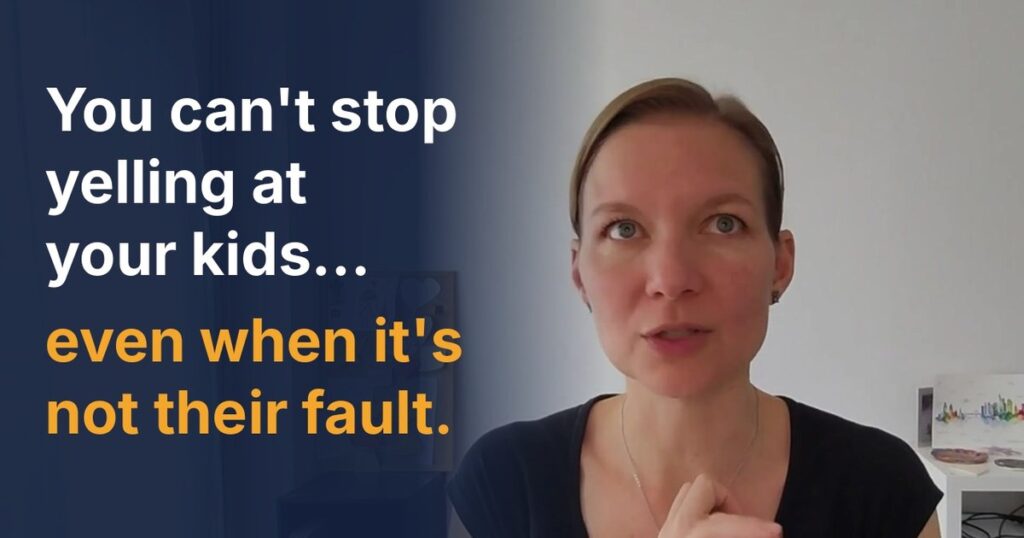
If you yell at your kids even when it isn’t their fault, it’s not because you’re not trying hard enough. It’s because calming yourself down when you’re alone and staying calm in the heat of the moment with your kids are two different skills. Under pressure, your generational autopilot (the pattern in your nervous system you learned long before you became a mom) takes over faster than any technique you’ve learned. The first step to rewiring it is creating a pause, and that starts in your body, not in your head.

Why do I snap at my kids when they haven’t done anything wrong?
Your child is whining, clinging to your leg, or has just gotten hurt. And instead of comforting them, you snap. Then you lie in bed at night replaying the scared look on their face and asking yourself: how come I did that? And how come it keeps happening, no matter how much I hate myself for it?
If that’s you, you’re not alone. I used to be that mom. I call myself my daughter’s first bully, very openly, because I feel we don’t talk about this enough. In those moments, my anger felt stronger than my love for my daughter, and I thought I was the worst mom in the world.
Why can I stay calm at work but not at home?
I hear this all the time from moms who are corporate lawyers, surgeons, therapists, even parenting coaches. They’re focused and professional at work. They handle crisis situations. Then they come home in the evening, pick the kids up from daycare, close the door… and lose it.
Many of them are already calm 95% of the time. But that calm is often a silent kind: the anger, frustration and resentment are boiling inside, and sooner or later it comes out anyway.
Why don’t meditation, therapy or parenting books stop the yelling?
I’ve met moms who do an hour of yoga, meditation and journaling before the kids wake up. Then the kids walk into the kitchen and fight over their favorite cup, and the calm from the yoga mat is nowhere to be found.
I’ve met moms who spent 10, even 20 years in talk therapy. They understand exactly how it all connects to their childhood. But at bedtime, with a 9 PM work call waiting and the kids asking for a tenth fairy tale, all of that insight is gone.
And I was the mom who read every book: conscious parenting, attachment theory, gentle parenting, Montessori. I had it all in my smart brain. But when my daughter was too slow to put on her jacket on a relaxed Saturday afternoon, I lost it anyway. It didn’t even help to pin the techniques on the fridge, because in that moment, my brain got hijacked.
Being able to calm yourself down when you’re alone is a very different skill from staying calm in the middle of the heat with your kids, when time is ticking, they’re having big emotions, and there’s pressure on you from the outside. Nobody teaches that second skill.
Why do I explode over small things like spilled water?
Because it accumulates. All the moments during the week when you didn’t yell, when you stayed silently calm and swallowed your frustration, add up. So one day your child spills water, something you normally wouldn’t mind, and everything that built up comes out at once.
How do I start to stop yelling at my kids in the moment?
Step 1: realize it’s not about your kids. It’s not just about calming yourself down either. It’s your generational autopilot: a pattern in your nervous system that takes over whenever you’re under too much pressure. Stop spending your precious time and energy on things that aren’t designed for that.
Step 2: drop out of your head and into your body. High-achieving moms try to solve this with logic, information and willpower. Instead, the moment you notice anger, resentment or frustration rising, get physically in touch with your body in a discreet way: rub your fingers, wiggle your toes, touch your face or forehead, put a hand on your heart.
This brings you back to the present moment. It reminds your body: I am here, now. This isn’t about last week’s frustration or my fears about the future. It’s about what’s happening right now with my child. That creates a pause between the trigger and your reaction. In that space, you have a choice. You can still correct the behavior and hold the boundary, but from real calm, not fake calm.
Is creating a pause enough to stop yelling?
No, and it’s important to be honest about that. These two steps are how you start: they create the pause before you yell. What you do in that pause, and whether you can choose a different, healthier, more effective response to your child, is the next question. That takes more steps, and rewiring your generational autopilot for good takes time.
You might still yell today, even if you practice perfectly. You might yell tomorrow or next week. That’s okay. Your generational autopilot has been with you for decades, so it won’t disappear overnight. Creating the pause is a practice: you’ll get better at it over time. Staying calm under pressure is a skill that grows with practice, and creating a pause is the best way I know to get started. Then come the next steps: what to do in that pause.
Key takeaways
- Yelling when it’s not your kids’ fault is your generational autopilot taking over, not a lack of effort.
- Calming down alone and staying calm with your kids are two different skills.
- Stress accumulates, which is why small things can trigger big explosions.
- Getting into your body (fingers, toes, face, hand on heart) creates a pause before you react.
- The pause is where change starts, not where it ends. What you do in that pause is the next step.
Practice it with me for 5 days (free)
In my free 5-day challenge for moms, Cut Your Yelling in Half, we practice this together with one short video and one small practice each day. It starts Monday, November 9. 👉 Join the free challenge
🎧 Prefer to listen? Here’s the podcast episode:
FAQ
Is it normal to yell at your kids when they haven’t done anything wrong?
It’s very common, especially for moms who are under a lot of pressure. It usually has more to do with what’s been building up in you than with your child’s behavior.
Why don’t calming techniques work when I’m angry?
Under pressure, your generational autopilot reacts faster than your thinking brain. Most techniques require you to remember them, and in that moment you can’t.
How can I calm down quickly before I yell?
Get physically in touch with your body: rub your fingers, wiggle your toes, touch your face, or put a hand on your heart. It brings you back to the present moment and creates a pause.
Can I still set boundaries if I’m not yelling?
Yes. Once you’ve created a pause, you can still correct the behavior and stay consistent with the boundary, from real calm instead of suppressed anger.
How long does it take to stop yelling?
Creating a pause is a skill that grows with practice, and it’s only the first step. Rewiring the pattern underneath takes more steps and more time, because it took decades to form. Expect progress, not perfection.
Alena Gomes Rodrigues is a Mommy Tantrum Specialist and the founder of Zen Supermom. She helps working moms stop yelling by rewiring their generational autopilot. She has worked with over 300 moms personally, and more than 20,000 have joined her free trainings.